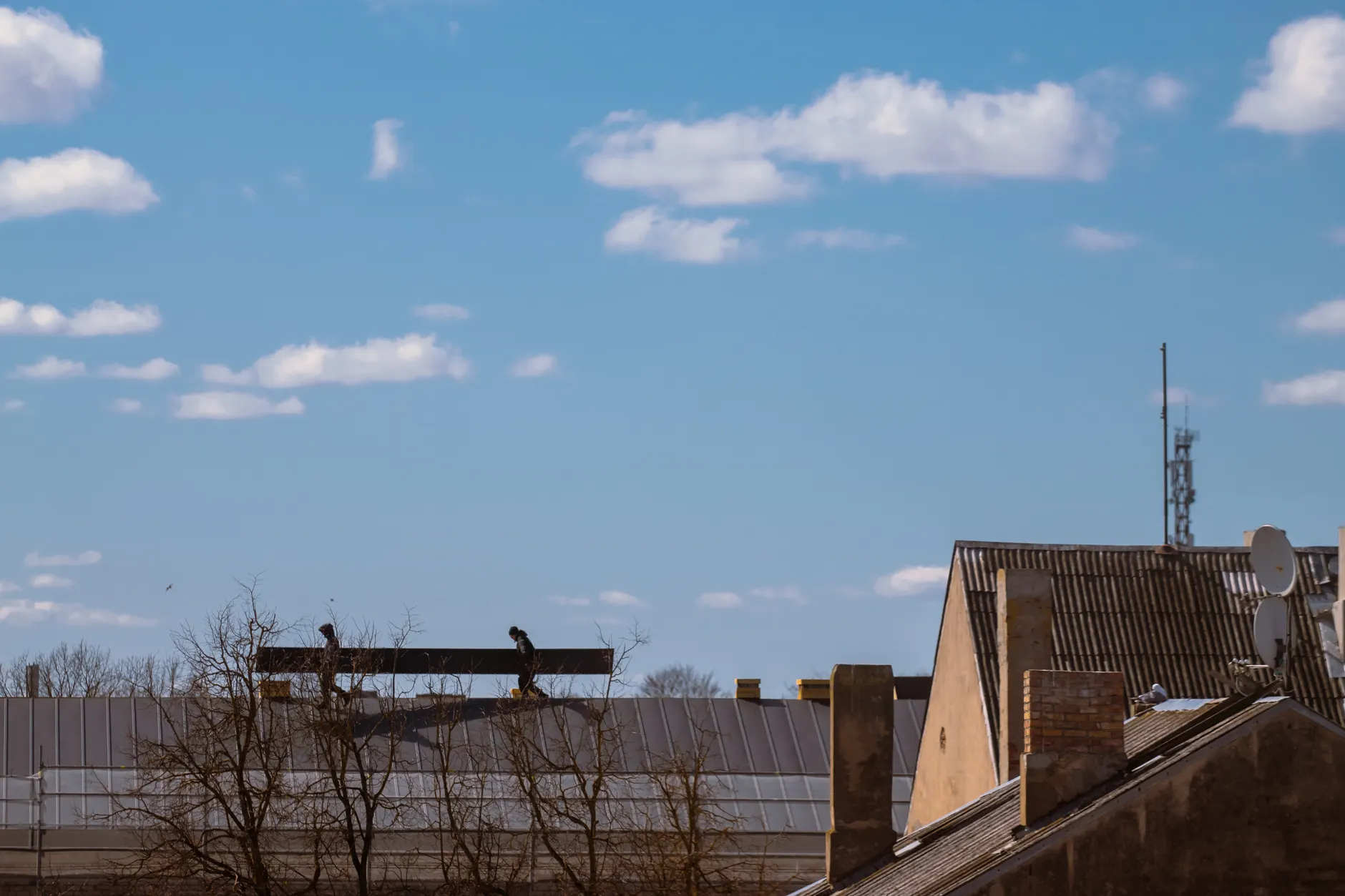
Newcastle Roofer Restoration Company has spent eighteen years on roofs that ignore the clock: a ridge lifted off a Tyneside flat at 2am when the wind funnels up the Tyne, slates sliding down a Jesmond terrace on a wet Friday night, a chimney flashing that finally gives out mid-storm and lets water into two households at once.
We started the firm in 2008 from a base on Benton Road in High Heaton, and we built it around this city on purpose — because the Welsh-slate terraces, the two-door Tyneside flats, the chimney stacks and lead valleys, and the exposed coastal weather all reward a roofer who already knows the patch. We are open 24 hours, and every job starts with a free roof survey and a fixed written quote before a single slate is lifted. What follows is the plain account of who we are and why eighteen years working this exact roofscape and this exact weather counts for more than it sounds.
How We Started, and Why We Stayed on Tyneside
We set up on Benton Road in 2008, in the NE7 belt where High Heaton runs into Gosforth, and made an early decision that shaped everything since: know one city's roofs properly rather than chase work across the whole North East. They started on the Welsh-slate terraces and Tyneside flats of Heaton and Sandyford — the stock the inner city is built from — before the work naturally drew us out to Gosforth's bigger villa roofs, Jesmond's conservation streets and Wallsend's wind-exposed shipbuilders' terraces. Eighteen years on, the underlying jobs have barely changed even as the buildings have weathered further: slate slipping and going nail-sick, lead perishing around the stacks, and the wind and frost finding every weak fixing.
Tyneside Flats and Welsh Slate Are a Roofing Description, Not Just History
Newcastle's inner roofscape was built out hard from the 1870s until 1914 to house the shipyard and engineering workforce, and it left a very specific reality overhead: dense Victorian and Edwardian brick terraces and the distinctive Tyneside flats — two front doors under one roof, so a single roof repair sits over two households — roofed predominantly in natural Welsh slate. The oldest terraces carry lead-lined valleys between the paired pitches and lead soakers and flashings around the shared chimney stacks. Those are the classic North East failure points: slate slips and nail sickness, cracked mortar fillets, and perished lead that lets driving rain track in. It is the reason slate re-fixing, valley and chimney lead work and full re-slates are everyday jobs here rather than rarities.
Coastal Wind and Freeze-Thaw Are the One Thread Through Every Postcode
Whatever the era of the roof, one thing does not vary across the patch: the weather working at it. Newcastle sits on the exposed coastal plain by the mouth of the Tyne, catching North Sea wind and driving rain, and cycles repeatedly through hard frost — a record low of minus 14 degrees and typically five to ten days of lying snow a year. That regime does not read postcodes; it lifts and delaminates slate, cracks tiles, strips ridges and verges and opens lead flashings whether the roof sits on a Heaton terrace or a Wallsend semi. Storm Arwen in November 2021, with its unusual northerly winds, was the sharpest recent proof of it across the North East. Eighteen years of turning out to that exact wind and frost is what turns storm-damage response from a scramble into routine.
Three Areas, Three Genuinely Different Roofs
The three areas beyond central Newcastle were not built in one decade, and their roofs show it.
Gosforth: Bigger Villas, More Ridge and Valley Length
Gosforth is bigger pitched roofs — large late-Edwardian villas and substantial 1930s hipped clay-tile semis with more ridge, hip and valley length and more chimney flashing than the inner terraces, much of it inside the 2002 conservation area.
Jesmond: Dense Terraces Under Three Conservation Areas
Jesmond is among the densest period roofscapes in the city, prestigious 1858–1898 terraces alongside street after street of Tyneside flats under heavy student-let ownership, with three conservation areas requiring matched slate on any repair.
Wallsend: Shipbuilders' Terraces Under North Tyneside Council
Wallsend is different again: denser shipbuilders' and colliers' terraces and interwar estates right by the Tyne mouth, the most openly wind-exposed of the four — and, crucially, in North Tyneside, so building control runs through North Tyneside Council, not Newcastle.
Matching the Right Roofer to the Right Roof
We coordinate the roofers we work with rather than running one fixed team, and the point of that is fit. Re-slating a conservation-controlled terrace in matching natural slate, stripping and re-covering a garage or extension flat roof, and re-leading a chimney stack after a storm are not interchangeable jobs, so we send the person set up for the actual scope in front of us. Slating and tiling follows BS 5534 for mechanical fixing and wind uplift, flat-roof work follows BS 6229 with reinforced bitumen membranes to BS 8217 and BS 8747 where felt is used, and leadwork follows BS EN 12588 for rolled lead sheet to the recognised lead codes. Ask on the call and we will confirm exactly who is scheduled before anyone arrives.
Two Councils, Several Conservation Layers
Most of what we cover sits inside the City of Newcastle upon Tyne — central Newcastle, Gosforth and Jesmond — so building control for those addresses runs through Newcastle City Council. Wallsend is the exception: it lies in the Metropolitan Borough of North Tyneside, so its building control and works notification run through North Tyneside Council, and we keep the two authorities straight rather than treating Tyneside as one. Layered on top is the conservation detail: Grainger Town and the Quayside in the centre, the Gosforth Conservation Area from 2002, and the Brandling Village, South Jesmond and Jesmond Dene areas in Jesmond all require external roof alterations and material changes to be consented and matched. We confirm what actually applies to a given address before any notifiable roof job, rather than discovering it halfway through.
If We Cannot Take the Roof On, the Job Still Gets Seen To
Some roofs are not ours to take. A storm fills the diary in a single night, a job needs access equipment or a specialism the roofers we coordinate do not carry, or the address sits well outside Newcastle, Jesmond, Gosforth and Wallsend. You will be told that plainly, while the weather is still the problem. Instead we put you in touch with one of the partner roofing firms we refer Tyneside customers to, so somebody still comes out to look at the job. That partner firm quotes it, invoices it and takes payment directly with you from there — none of the money passes through us once the introduction is made, and how we work sets out that same process in full. Passing somebody on this way still beats leaving them under a roof that is letting water in, and that is what ringing 07460 067785 gets you.
If you are weighing us against the first name a search throws up, start with the home page for the full picture of what we cover, browse the complete list of roofing services, see what customers have said, or get in touch directly to talk through what is happening on your roof. Either way, the same two owners and the same coordinated roofers answer the phone.